
Last updated November 16, 2026
 AC repair
 Furnace & heating
 Heat pumps
 Ductless mini splits
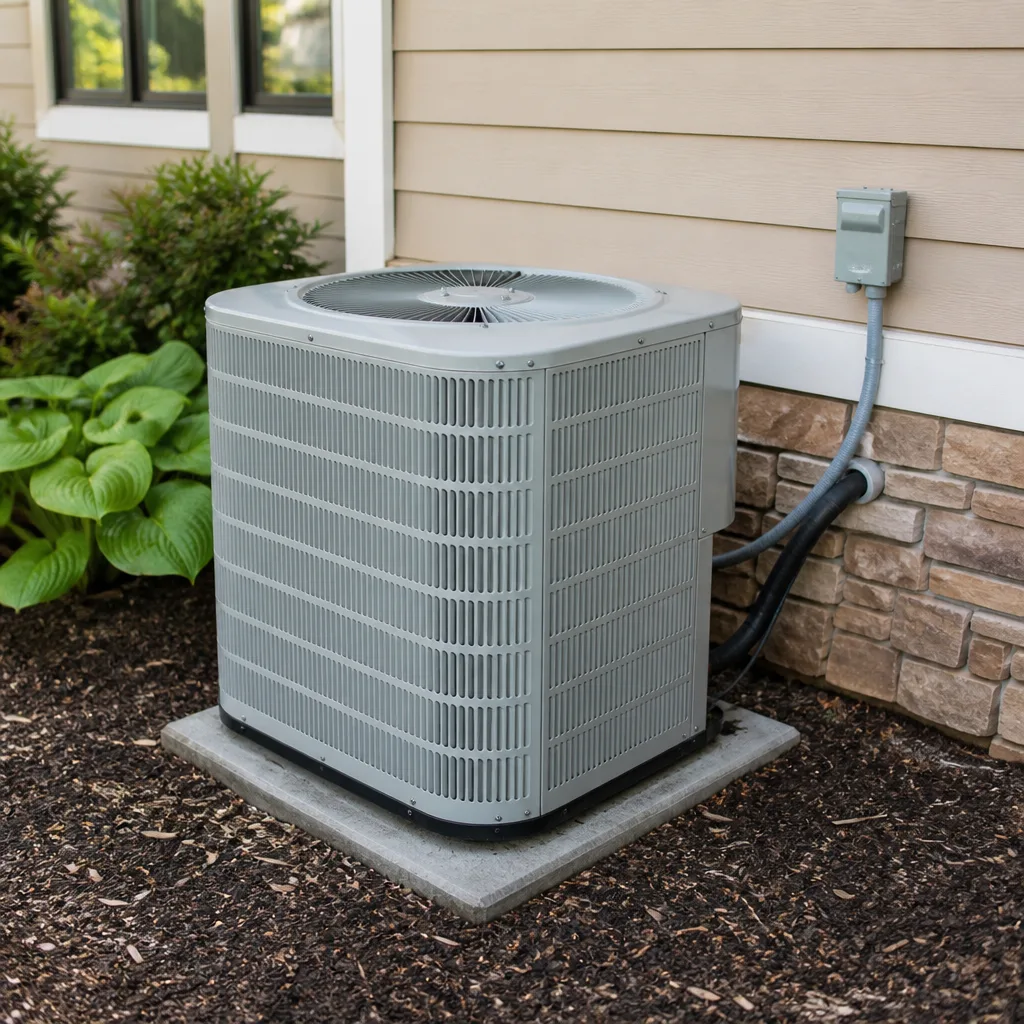 Carrier
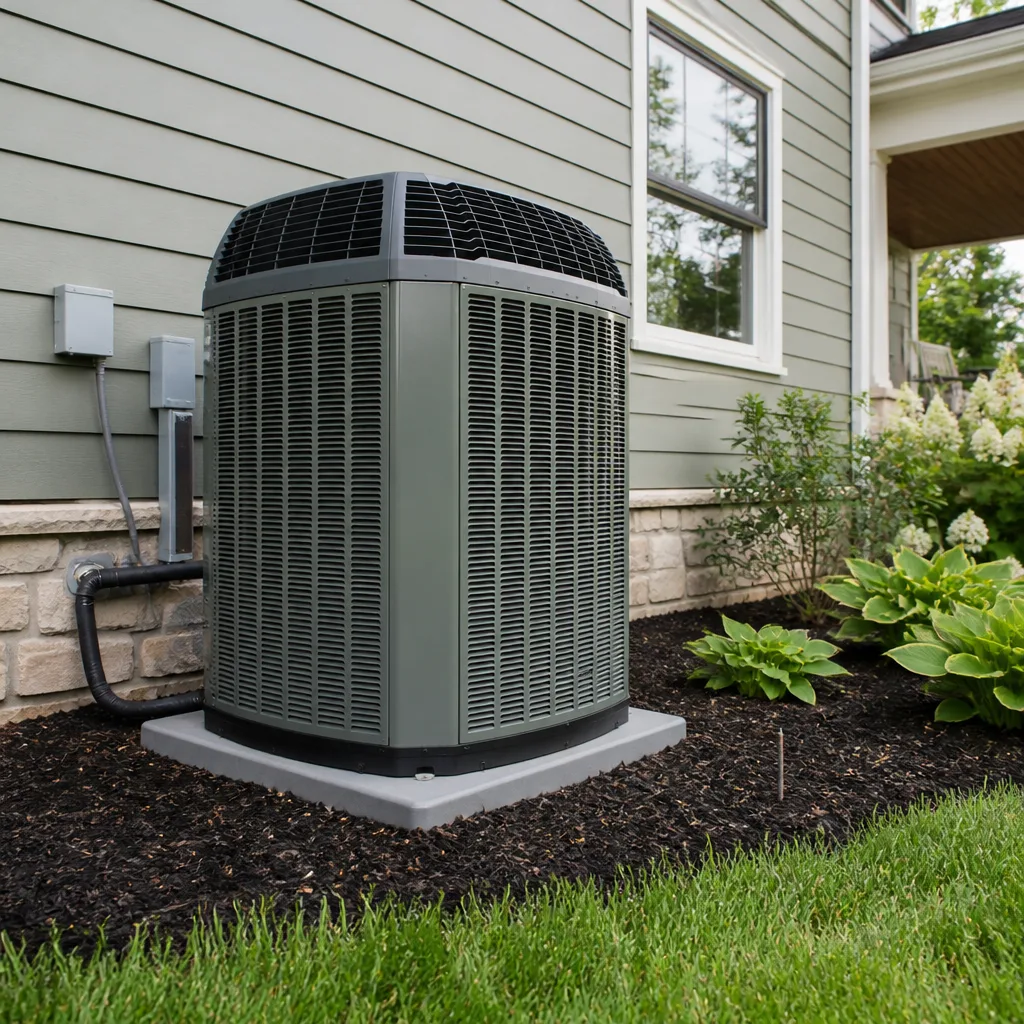 Trane
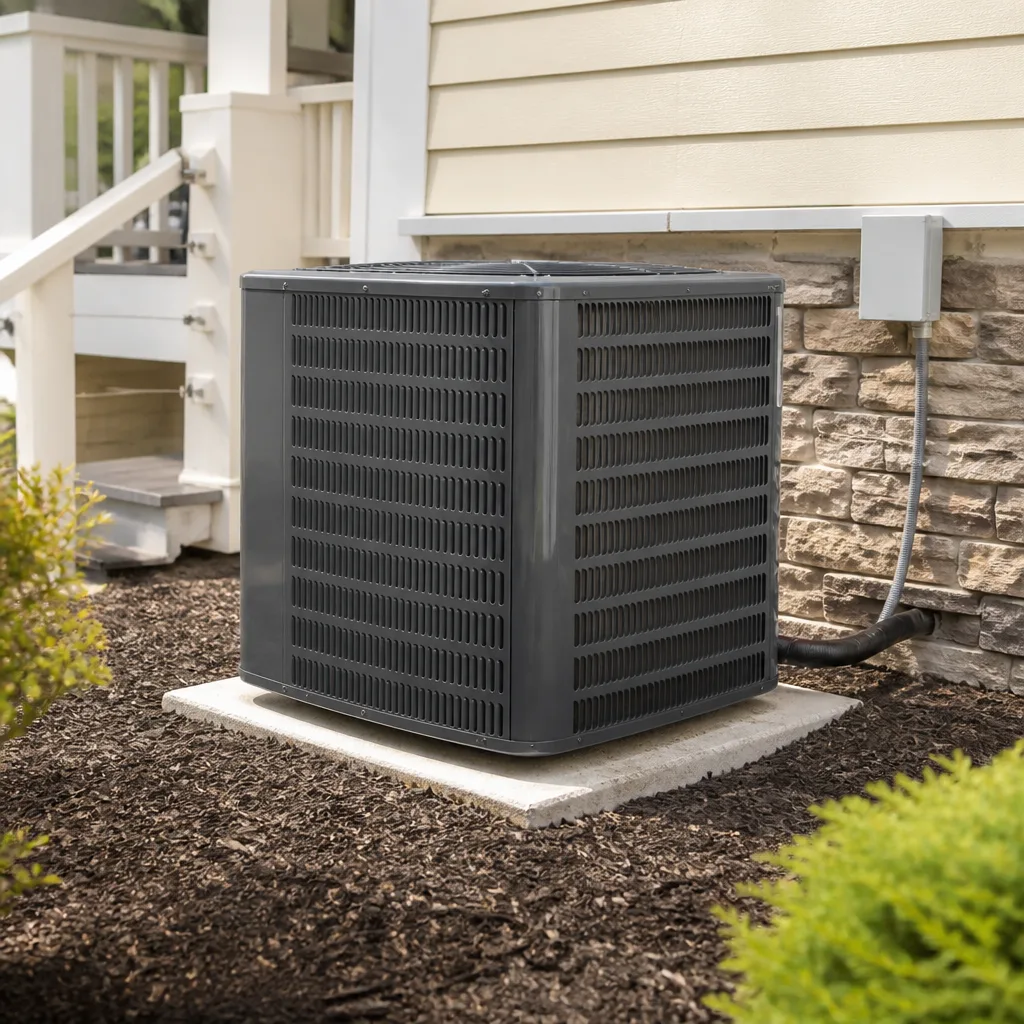 Goodman
Seasonal tune-up and full diagnostic on your Carrier, Trane, or Goodman system - readings shown to you before any repair is proposed
Diagnosis first, numbers second - you approve the repair price before a single part goes in.
Get your free estimateDIY vs Professional HVAC: The Grand Prairie Homeowner’s Decision Guide
Replacing your own capacitor costs about $20 in parts and is perfectly legal in Texas. Recharging your own refrigerant is a federal EPA violation that carries fines up to $44,539 per day, and plenty of YouTube tutorials will walk you through it without ever mentioning that. That gap between what feels like the same kind of job and what the law actually allows is where most Grand Prairie homeowners get into trouble. This guide draws a clear line: which repairs you can safely and legally do yourself, which ones require a licensed technician, and what the real cost of getting it wrong looks like in a North Texas summer.
Quick Answer
In Grand Prairie, you can legally and safely handle basic DIY tasks like replacing a thermostat, swapping an air filter, cleaning the outdoor condenser coil, replacing a capacitor, and clearing a blocked condensate drain. Everything involving refrigerant handling, electrical panel connections, gas line work, or compressor-level diagnosis requires a licensed technician under Texas TDLR rules and EPA Section 608 regulations. The DIY-versus-pro decision isn’t really about skill level; it’s about legal exposure, warranty protection, and insurance coverage when something fails.
Styles & brands we work with
- AC repair
- Furnace & heating
- Heat pumps
- Ductless mini splits
- Carrier
- Trane
- Goodman
Table of Contents
- Where Texas Law Draws the Line on DIY HVAC Work
- The Five DIY Tasks That Are Genuinely Safe and Legal
- Why DIY Refrigerant Work Is a Federal Violation, Not Just a Bad Idea
- How DIY Electrical Work Affects Your Homeowner’s Insurance
- The Hidden Cost of a Wrong Diagnosis in Grand Prairie Heat
- What DIY Repair Does to Your Equipment Warranty
- A Repair-or-Replace Framework for Older Systems
- What Brand-Specific Knowledge Actually Buys You
Where Texas Law Draws the Line on DIY HVAC Work
Texas doesn’t have a blanket rule against homeowners touching their HVAC system, but it does have strict rules about certain tasks. The Texas Department of Licensing and Regulation (TDLR) requires a license for anyone who performs air conditioning and refrigeration work for compensation. The key phrase there is “for compensation.” A homeowner working on their own equipment isn’t running a contracting business, so the TDLR rule doesn’t directly bar you from picking up a wrench.
But two federal layers sit on top of that:
- EPA Section 608 prohibits anyone without proper certification from handling, buying, or disposing of refrigerants. This applies regardless of whether money changes hands. A homeowner cannot legally buy R-410A or R-22, let alone charge a system.
- The Clean Air Act underlies Section 608 and carries the enforcement teeth. Penalties for knowingly violating refrigerant handling rules can reach $44,539 per day per violation.
On the electrical side, local permitting governs. Most cities, including Grand Prairie, require a permit for new circuits, panel changes, and certain HVAC electrical work. If you’re unsure whether your task requires a permit, the safe move is to ask the city’s building department before you start. The permitting requirement exists so that work gets inspected, and inspections protect you at resale.
The practical upshot: the law carves out a narrow but useful DIY zone. Replacing a capacitor? Legal. Cleaning a coil? Legal. Tapping into a refrigerant line? Federal violation. Wiring a new disconnect box without a permit? That’s where resale headaches start. Knowing which side of that line you’re on is the whole game.
The Five DIY Tasks That Are Genuinely Safe and Legal
These five jobs are the ones we’d genuinely tell a friend to try themselves before calling anyone. They’re cheap, they don’t touch refrigerant or high-voltage panel work, and they don’t void warranties when done correctly.
- Replacing the air filter. A dirty filter chokes airflow and forces the blower to work harder. Change it every 30 to 90 days depending on dust and pets. This is the single highest-value DIY task in HVAC, full stop.
- Cleaning the outdoor condenser coil. Shut off power at the breaker, then rinse the coil fins from the inside out with a garden hose. Grand Prairie’s spring pollen and summer dust cake onto that coil fast, and a dirty coil can add real load to the compressor.
- Clearing a blocked condensate drain line. If you see water pooling near the indoor unit, the drain line is probably clogged with algae. A shop vac on the outdoor end of the line, or a quick flush with vinegar, often clears it. This is one of the most common no-cooling calls we get, and it’s frequently a homeowner fix.
- Replacing a run capacitor. A bulging or leaking capacitor is a common failure, and swapping a matching-spec capacitor is genuinely within reach for a careful homeowner. Turn off power at the breaker first, discharge the capacitor safely, and match the microfarad rating exactly. If you’re not comfortable working near stored electrical charge, don’t.
- Replacing a thermostat. If your thermostat is a standard low-voltage unit (typically 24V control wiring), swapping it for a compatible model is straightforward. Photograph the wiring before you disconnect anything, and follow the manufacturer’s wiring diagram. This is also where a stuck thermostat can mimic a much bigger problem.
What these five tasks share is that they don’t require refrigerant, don’t touch the electrical panel, don’t open the gas line, and don’t ask you to interpret diagnostic readings. They’re maintenance and part-swaps with clear pass/fail criteria.
Why DIY Refrigerant Work Is a Federal Violation, Not Just a Bad Idea
This is the section most DIY tutorials skip. Handling refrigerant without EPA Section 608 certification is a federal violation, period. It’s not a gray area, it’s not a “technically illegal but nobody cares” situation, and it’s not something a homeowner can wave off by being careful. The refrigerant itself can’t legally be sold to a non-certified person in the first place.
Beyond the legal exposure, there’s the practical reality:
- You can’t buy the refrigerant. Supply houses check certification. A homeowner walking in for a jug of R-410A gets turned away.
- You need recovery and charging equipment. A proper recharge requires a recovery machine, manifold gauges, a vacuum pump, and a scale. That’s hundreds of dollars in tools for a job you might do once.
- You need to find the leak, not just top off the charge. Refrigerant doesn’t get “used up” in a sealed system. If the charge is low, there’s a leak. Topping it off without finding the leak just postpones the failure, and it wastes refrigerant you can’t legally buy anyway.
- Overcharging damages the compressor. Slugging a compressor with liquid refrigerant, or overcharging the system, can destroy it. That’s a multi-thousand-dollar mistake from a $50 shortcut.
Enforcement reality in Texas is real: EPA regional enforcement has pursued both contractors and homeowners in cases involving illegal venting or unlicensed handling. The fine structure is designed to discourage exactly the behavior that YouTube tutorials make look easy. If a video tells you to “just top it off,” it’s telling you to break federal law.
This is also where brand knowledge matters. We work on Trane and Lennox systems regularly, and both use specific charge procedures and refrigerant types. A generic top-off on a Trane system with the wrong refrigerant blend is worse than doing nothing. For proper refrigerant work on your system, our Stallion AC Repair team handles it under EPA rules.
How DIY Electrical Work Affects Your Homeowner’s Insurance
This is the risk most Grand Prairie homeowners never think about until it’s too late. If an HVAC electrical fire or failure traces back to unpermitted, uninspected DIY work, your homeowner’s insurance carrier can deny the claim. That’s not hypothetical; it’s written into most standard policies under the “faulty workmanship” or “unpermitted work” exclusions.
Here’s the sequence that plays out:
- You replace a disconnect box, add a circuit, or tap into the panel yourself without a permit.
- Months or years later, an electrical fault causes a fire or fries the compressor.
- The insurance adjuster investigates and asks for the permit record and inspection sign-off.
- There isn’t one. The claim gets denied or heavily reduced.
The same logic applies at resale. A buyer’s inspector will flag unpermitted electrical work on an HVAC system, and that flag can stall a sale or force you to pay for a retroactive permit and inspection. In Grand Prairie’s competitive resale market, that’s a real negotiating chip you don’t want to hand over.
The safe rule is simple: any HVAC task that touches the electrical panel, adds a new circuit, or changes the disconnect requires a permit and a licensed electrician or HVAC technician. Capacitors and thermostats (low-voltage) are the homeowner-legal exceptions because they don’t modify the panel or create new circuits. Anything else, call a licensed pro. Our AC installation work always includes the permitting and inspection piece, which is exactly the protection you want attaching to your system.
The Hidden Cost of a Wrong Diagnosis in Grand Prairie Heat
Here’s the scenario that costs people the most money in this trade: a system stops cooling, the homeowner diagnoses it as a bad capacitor because the internet says so, swaps it, and the system runs again, sort of. Three weeks later the compressor dies. The capacitor wasn’t the problem; it was a symptom of a compressor drawing too much current because of a failing start winding or a restricted metering device. The $20 capacitor swap masked a $3,000 problem.
Grand Prairie’s summers make this worse. Our typical July and August afternoons push the outdoor unit past 105°F ambient, and a struggling compressor runs longer and hotter under that load. A misdiagnosed minor issue that would have been a simple fix in April becomes a full compressor or system replacement by August because the system ran at high head pressure for weeks while the homeowner thought they’d fixed it.
The math is stark:
- Proper diagnosis on day one: a licensed technician finds the failing winding, replaces the component, and the system runs normally.
- DIY misdiagnosis: the capacitor gets swapped, the compressor fails weeks later, and you’re pricing a new condenser or an entire system.
We’ve seen this cycle enough times to know it’s not rare. It’s the default outcome when a homeowner replaces a symptom instead of diagnosing a cause. Capacitor replacement is on our safe-DIY list because it’s a legitimate fix when the capacitor is genuinely the problem. It stops being safe when it becomes a guess.
The Grand Prairie specific factor here is heat duration. Our cooling season runs long. A system that limps through a mild summer might survive, but a system limping through a Grand Prairie summer with a masked compressor problem won’t. The earlier the diagnosis, the cheaper the fix.
What DIY Repair Does to Your Equipment Warranty
Equipment manufacturers build warranty terms that protect them from homeowner-installed or unqualified work. On a Carrier, Bryant, or American Standard system, the parts warranty typically requires that repairs be performed by a licensed technician for the warranty to remain valid. Swap a capacitor yourself and that specific repair may not be covered if it fails again; open the refrigerant circuit and you can void the compressor warranty entirely.
This matters most on newer equipment. If you bought a system in the last few years, the parts warranty is one of the most valuable things attached to your equipment. A Goodman or Rheem condenser sitting under a ten-year parts warranty is worth real money in a replacement scenario. Voiding that warranty to save a service call is a bad trade.
The practical guidance:
- Check your warranty documents before any DIY work. Most manufacturers post warranty terms online for your model and serial number.
- Capacitor, thermostat, and filter changes are usually warranty-safe. These are considered maintenance-level items by most manufacturers, but confirm for your specific brand.
- Any refrigerant or compressor-touching work is warranty-critical. Have it done by a licensed technician, and keep the invoice.
When you call us for furnace repair or AC work, the invoice you receive is also your warranty documentation. That paper trail matters if the repair fails within the manufacturer’s coverage window.
A Repair-or-Replace Framework for Older Systems
Once a system gets past roughly 10 to 12 years old, the DIY-versus-pro question expands into a repair-versus-replace question. Here’s the framework we use when a homeowner asks us for a straight answer.
- Age and refrigerant type. If the system uses R-22, it’s reaching end of life by definition because R-22 is phased out and no longer produced domestically. If it uses R-410A and is over 12 years old, repair costs start to climb.
- Repair cost as a percentage of replacement. A common rule of thumb: if the repair costs more than a third of a new system’s installed price, replacement often makes more sense, especially on older equipment.
- Repair frequency. One repair a year is normal maintenance. Two or three major repairs in two years is a system telling you something.
- Efficiency gap. Older systems run at lower efficiency than current models. In Grand Prairie, where the cooling season is long, that efficiency gap shows up on every utility bill.
- Compressor health. A failing compressor on a 12-year-old system usually pushes toward replacement. A failing compressor on a 5-year-old system is a straightforward repair.
We work on Carrier, Trane, Lennox, Goodman, Rheem, York, Daikin, Bryant, and American Standard, so we can give you honest brand-specific guidance on whether a repair is worth doing on your specific equipment. If you’re shopping for a new system, our Grand Prairie team can walk you through both premium and value-tier options so the recommendation matches your budget, not what’s convenient to sell.
What Brand-Specific Knowledge Actually Buys You
Here’s a thing most homeowners don’t realize: HVAC brands differ meaningfully in how they fail. A Trane compressor has different failure signatures than a Goodman. A Lennox control board has different diagnostic codes than a Rheem. A technician who works across all of them carries the pattern recognition that lets them skip the trial-and-error and go straight to the likely cause.
That matters more than it sounds in a DIY-vs-pro decision because it changes the economics of calling someone. When a tech knows your brand before they arrive, you’re not paying for diagnostic exploration; you’re paying for a specific fix. Our technicians have up to 12 years of experience across nine leading brands, and the difference shows up in how fast a diagnosis lands.
It also changes the repair-or-replace conversation. A generalist who mostly installs one brand tends to recommend that brand when replacement comes up. A multi-brand specialist has a reason to give you the honest answer, because they’ll be the one servicing whatever you choose. We lead with Carrier, Trane, and Lennox on the premium side and Goodman and Rheem on the value side, and we’ll tell you which fits your home and your budget.
When we assess a repair on your existing system, the brand knowledge also tells us whether a part failure is a one-off or the first sign of a pattern. That’s the difference between a repair and a wasted repair.
Common Mistakes to Avoid
- Trying to buy refrigerant as a homeowner. You can’t legally buy R-410A or R-22 without EPA Section 608 certification. Any tutorial that prompts you to “just pick up a jug” is skipping the federal rule and the $44,539 daily penalty that comes with it.
- Assuming a capacitor is always the answer. In Grand Prairie’s long cooling season, a capacitor swap can mask a failing compressor for weeks. Diagnose the root cause before you replace the part.
- Doing electrical work without a permit. Adding a circuit, replacing a disconnect, or tapping into the panel without a permit can void your homeowner’s insurance coverage if a fire or failure happens. Permits and inspections protect you at resale.
- Voiding a parts warranty to save a service call. Most manufacturer warranties require licensed repair. Confirm your warranty terms before any DIY work that touches refrigerant or the compressor.
- Ignoring the condensate drain until it floods. Grand Prairie’s humidity means that drain line clogs regularly. A quick flush with vinegar a couple of times a year prevents the ceiling stains, and it’s free.
- Chasing the lowest install bid. A cheap install that skips the load calculation or the permit record costs you more at resale and on every summer utility bill. The right system for your home is worth more than the lowest price on the truck.
- Running a system with an unknown failure mode. If the system shuts off repeatedly or the breaker trips, stop restarting it. Repeated restarts on a failing compressor accelerate the damage faster than most homeowners realize.
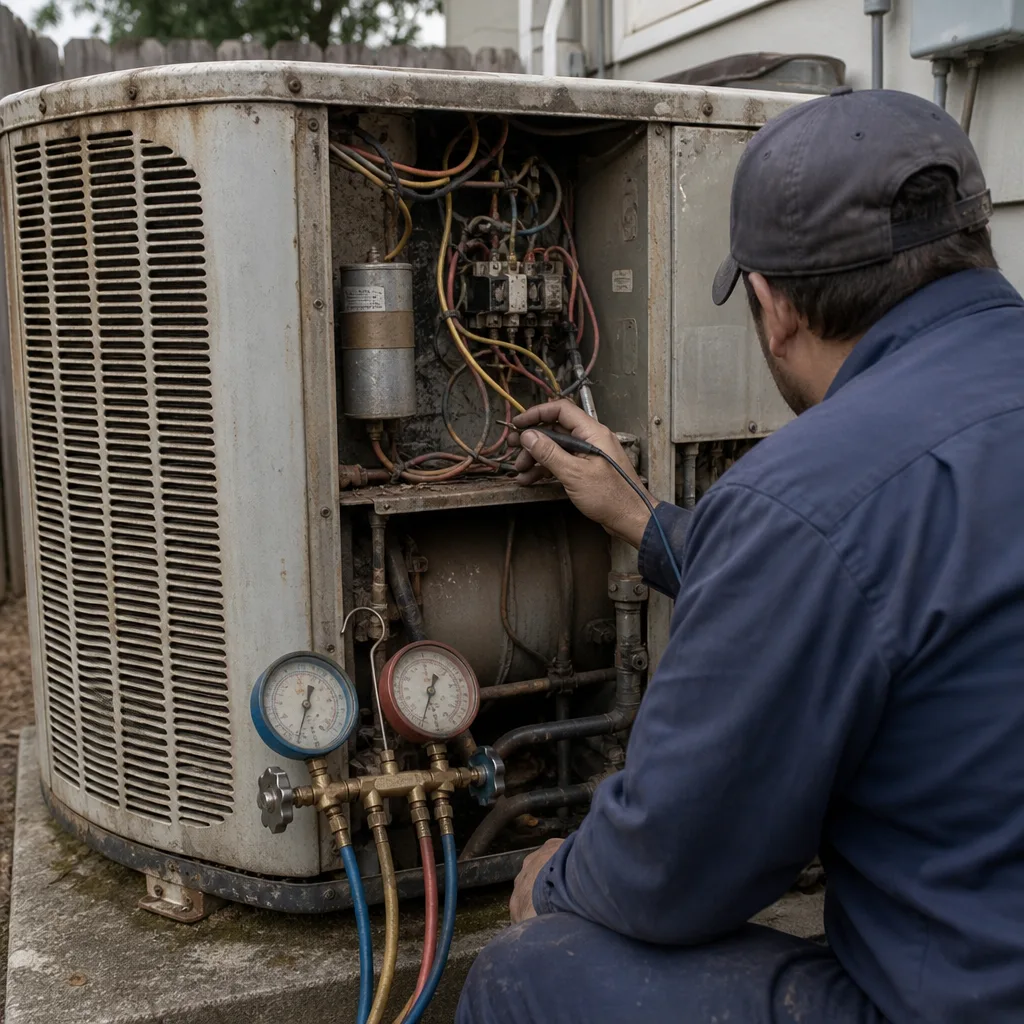
See the difference
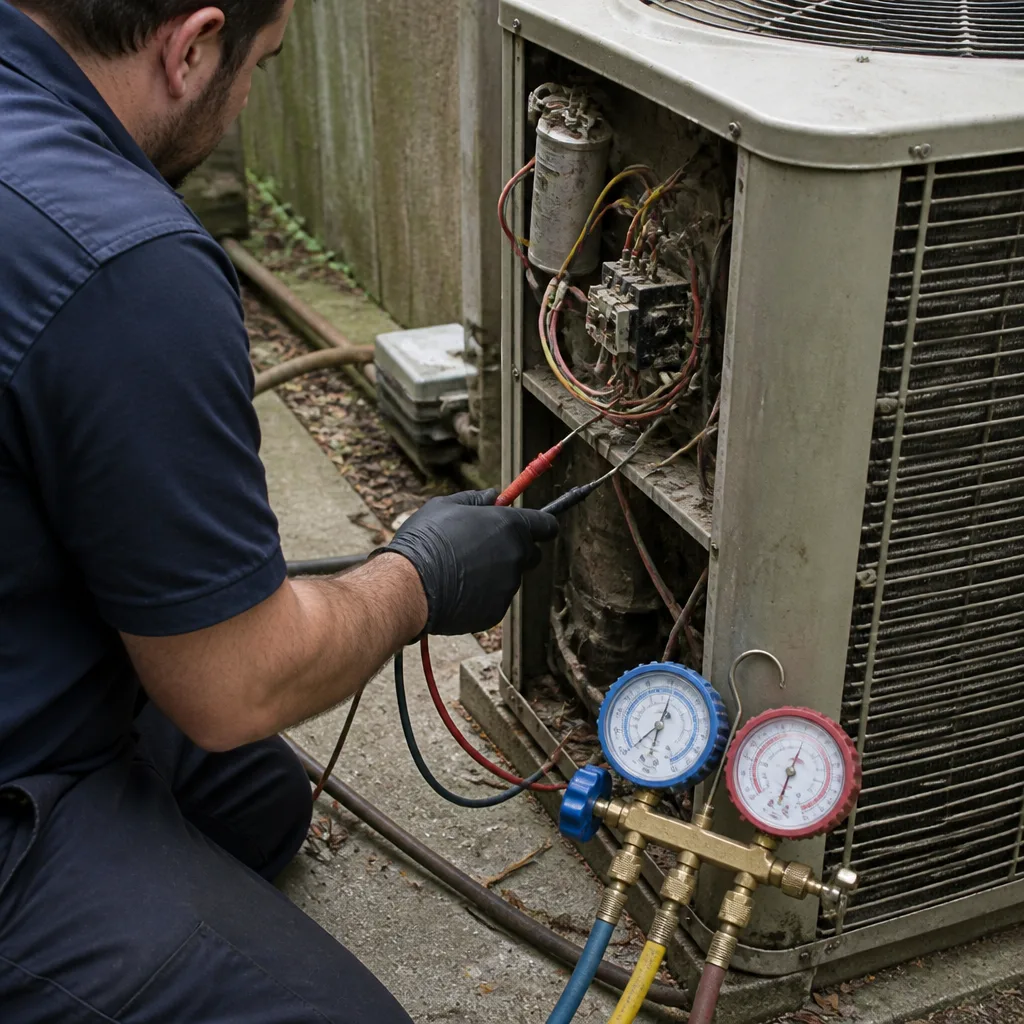 Before
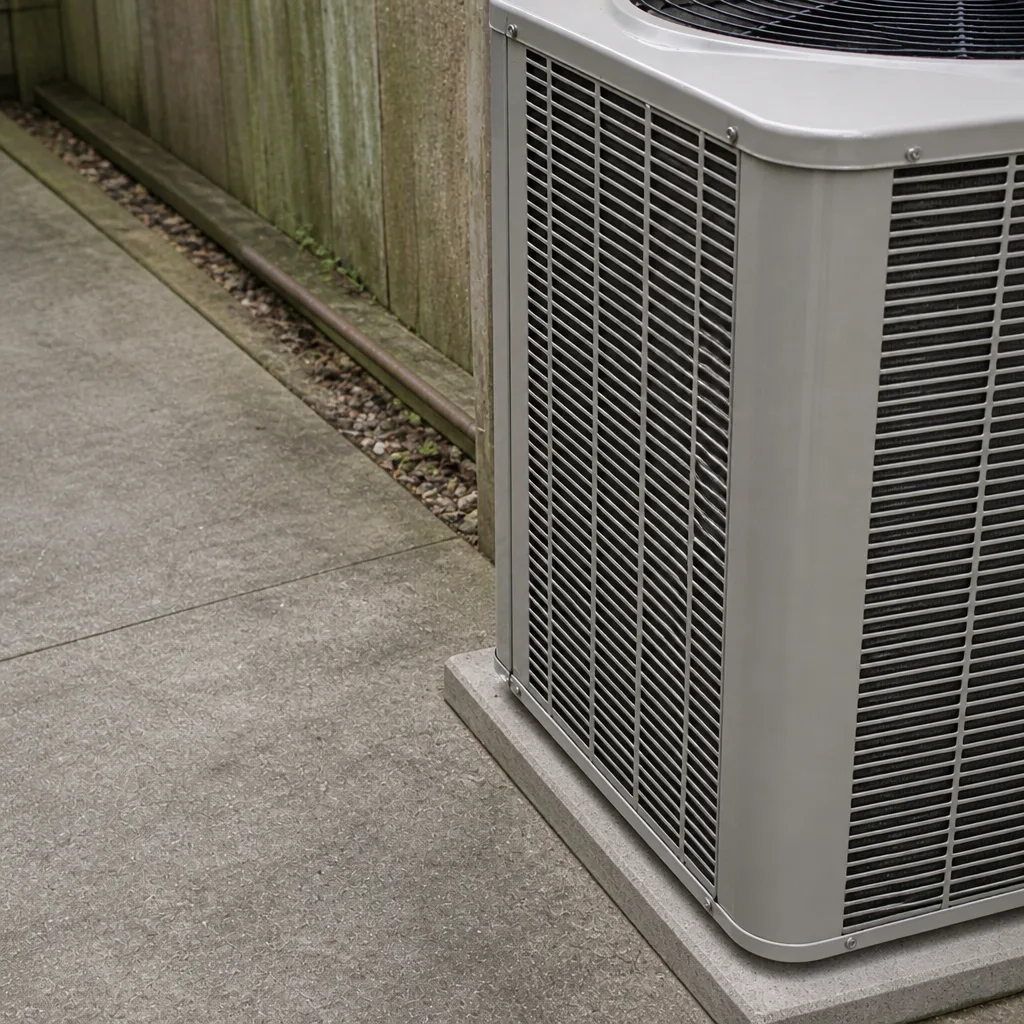 After
 Before
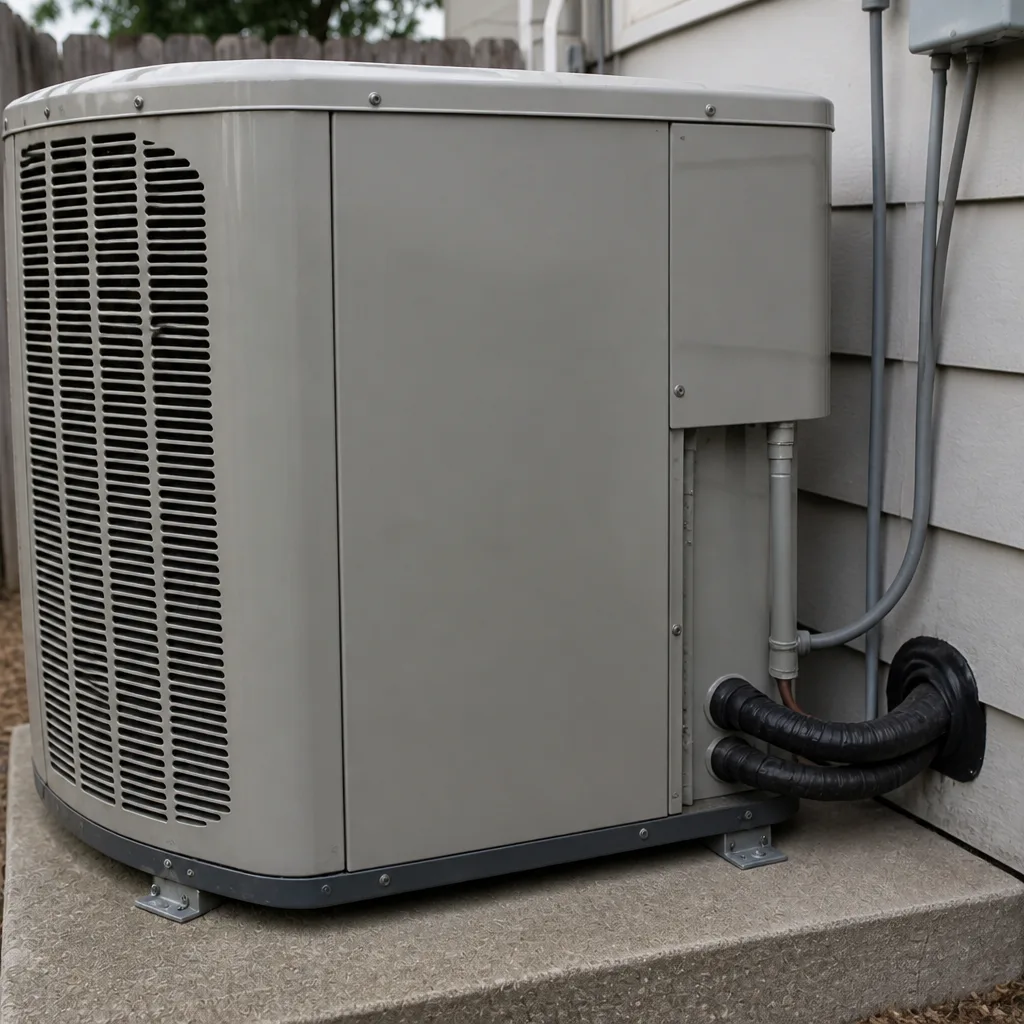 After
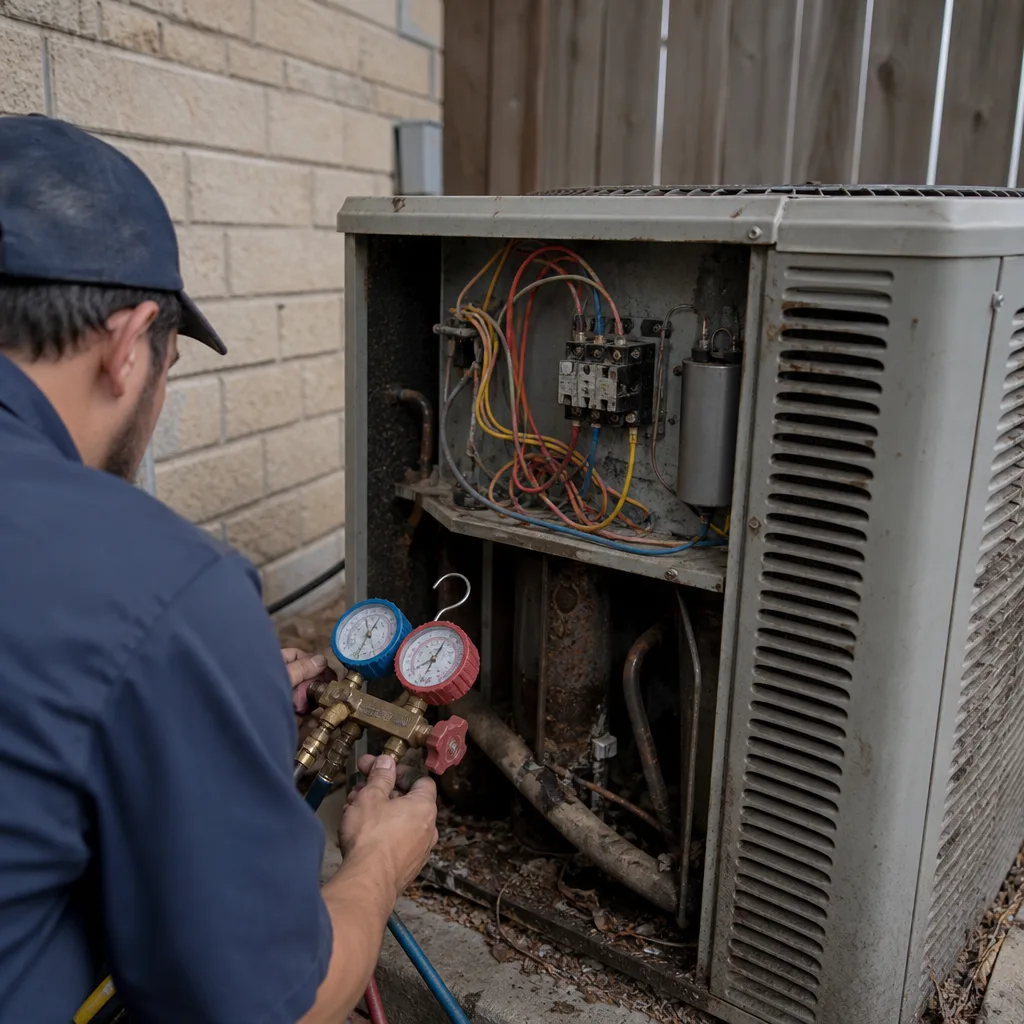 Before
 After
When to Call a Professional
Call a licensed technician if any of these are true: the system uses refrigerant and the charge is low; the breaker trips repeatedly; the outdoor unit won’t start; the system is over a decade old and cooling performance has dropped noticeably; you’re seeing ice on the indoor coil or the refrigerant lines; or you’re not certain what the problem is. Those scenarios sit on the wrong side of the legal line, the warranty line, or the diagnostic line, and all three are the places where DIY gets expensive.
Stallion AC Repair offers free estimates in Grand Prairie. Call (866) 942-9965. We answer 24/7. Fast dispatch from 7am to 7pm, Sunday through Friday. One contractor for your furnace, your AC, and everything in between.
Frequently Asked Questions
Yes. Replacing a run capacitor on your own residential system is legal in Texas, as long as you turn off power at the breaker, discharge the capacitor safely, and match the microfarad rating exactly. It’s a genuine homeowner-legal repair, but only when you’re certain the capacitor is the actual problem. Call (866) 942-9965 for a free estimate if you want a professional diagnosis first.
Yes, it’s a federal violation. Under EPA Section 608 of the Clean Air Act, handling, buying, or disposing of refrigerants without proper certification is illegal, and penalties for violations can reach $44,539 per day. You also can’t legally buy the refrigerant as a non-certified person. Call (866) 942-9965 for refrigerant work on your system – our technicians handle it legally and correctly.
It can. Most standard homeowner policies exclude coverage for unpermitted or faulty workmanship, and if a fire or failure traces back to DIY electrical work without a permit, the claim can be denied. Capacitor and thermostat swaps are usually fine because they don’t modify the panel or add circuits. Anything that touches the electrical panel or adds a circuit needs a permit and a licensed pro. Call us for a free estimate at (866) 942-9965.
You can turn a small repair into a system replacement. The most common scenario we see is a homeowner swapping a capacitor when the real problem is a failing compressor, and the compressor then fails weeks later because it ran at high head pressure through the summer. That’s typically a $3,000 difference between a proper day-one diagnosis and a post-failure replacement. Call (866) 942-9965 and get an accurate diagnosis before you guess.
Some HVAC work requires a permit, and some doesn’t. New circuits, panel changes, and certain electrical modifications typically require one, while part swaps like capacitors, thermostats, and filters don’t. The safe move is to ask the city’s building department before you start work that touches the electrical panel. For permitted installation work, call (866) 942-9965 for a free estimate.
Use three rules: refrigerant type, repair cost relative to replacement, and repair frequency. If the system uses R-22, it’s at end of life by default. If a repair costs more than about a third of a new system, or you’ve had two or three major repairs in two years, replacement usually makes more sense. Call (866) 942-9965 for a straight-talking repair-or-replace assessment on your brand of equipment.
The Bottom Line
The DIY-versus-pro decision in Grand Prairie isn’t mostly about skill. It’s about legal exposure, insurance coverage, and whether a guess costs you more than a call. Filter changes, coil cleaning, condensate drain flushes, thermostat swaps, and capacitor replacements are the safe DIY zone. Refrigerant work is a federal violation. Electrical panel work without a permit is an insurance and resale problem. And a misdiagnosed capacitor swap in a Grand Prairie summer is the difference between a small repair and a compressor replacement.
Know which side of the line you’re on, do the maintenance, and call a licensed technician when the problem touches refrigerant, the panel, or your warranty. If you’re not sure which side you’re on, that’s the signal to call.
Stallion AC Repair offers free estimates in Grand Prairie. Call (866) 942-9965. We answer 24/7. Fast dispatch from 7am to 7pm, Sunday through Friday. Whether you have a Trane, a Goodman, or anything on our brand list, we’ll give you the honest repair-or-replace answer your system deserves.
Written by the team at Stallion AC Repair.